
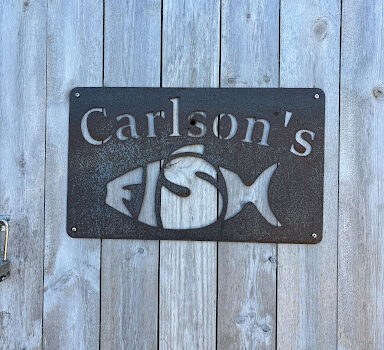
 The first thing I think of when I hear the word Fishtown is fish (duh), but more specifically, the SMELL of fish. Love it or hate it, it’s impossible to deny that this distinct aroma characterizes the town. If you have a keen sense of smell, you may be able to pinpoint where the scent is wafting from. Follow your nose, and it’ll lead you to the doors of Carlson’s fishery. For many, the lingering smell of fish in the air that sticks to people’s clothes and in their hair is not something that’s appreciated, but to me, it’s the smokiness blanketing Fishtown that is truly the smell of home.
For those who have been following my story since the beginning of summer, one of my first blogs highlighted my adventure with Joel Petersen, captain of the Joy. I spent a morning on the Joy watching Joel and his nephew pull in preset fish nets, and learned what it’s like to be an active commercial fisherman on Lake Michigan. We had a smaller catch of whitefish that day, and I remember ending that morning by helping him weigh the fish on the scale inside Carlson’s. Though my trip that day ended at Carlson’s, I knew I was bound to circle back and complete the journey of the whitefish before the summer ended. Forget farm to table, I wanted to experience the entire lake to table cycle a whitefish takes. 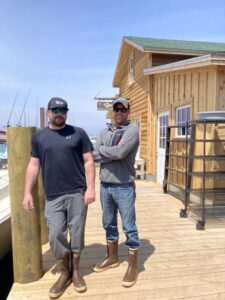
The Carlson name is synonymous with Fishtown, and the family has played a significant role in shaping Fishtown into the place that it is today. Emigrating from Norway, Nels Carlson moved from North Manitou Island to Leland in 1904, and bought a shanty in Fishtown where the family began their commercial fishing operations. In the 1960s they began to buy up property in Fishtown, with the hopes of preserving the shanties for the purpose of keeping commercial fishing alive. In fact, it was the Carlson’s who sold the shanties to the Fishtown Preservation Society (FPS) in 2007, and since then they’ve rented the fishery shanty from FPS. Over the years, the business has shifted from selling wholesale fish, and is now a storefront fishery that sells to the general public. The business has been passed down from the original Nels Carlson to Will, then to Lester, then Bill, and most recently to Nels who continues the family legacy as a fifth generation Carlson. About seven years ago, Michael Burda joined in coownership, and together, he and the current Nels run Carlson’s Fishery.
 Whitefish is Carlson’s dominating product, but they also process lake trout, Canadian north Atlantic salmon, and walleye. Their fish comes from all over Michigan, but they do their best to source as locally as possible. Joel Petersen brings whitefish in about once or twice a week on the Joy, but since he’s a commercial fisherman he’s limited to just whitefish. Bill Fowler out of Peshawbestown is another fisherman in the county that Carlson’s gets their fish from. As a licensed tribal fisherman, Bill’s allowed to catch more types of fish so he brings in a variety of whitefish, trout, walleye, and salmon. Today, the fishery has expanded from selling fresh filets to smoked fish, fish sausage, fish pate, beef and turkey jerky, and more recently added smoked turkey legs to their curated line up of products.
I chose to visit the fishery the same day Joel was bringing in a fresh catch of whitefish, that way I could pick up where I left off the last time and could guarantee that I’d 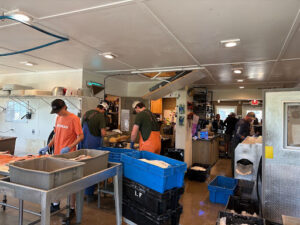 see the process from start to end. I should’ve known that I’d be walking into an explosion of activity. From the frantic flurry of fish being tossed into a weighing bin, to the sorting of fish to be sold fresh or smoked, I could barely make sense of what was going on around me. Somehow, as frenzied as it all seemed from my eyes, it was evident that the team was moving in a smooth rhythm. Each person had their own task, and they would weave back and forth amongst each other, the definition of a well oiled machine. Amidst it all, I was able to speak with Emily, a long time employee at Carlson’s who graciously gave me a tour of what a day in the life of working at Carlson’s was like.
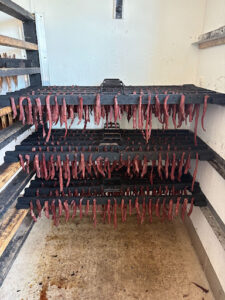
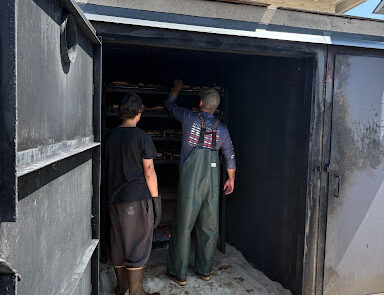
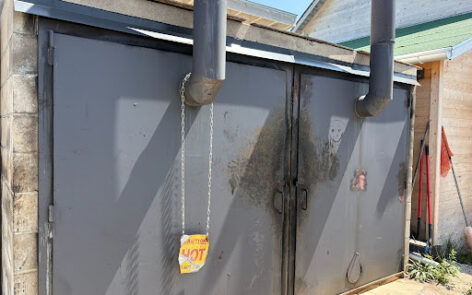
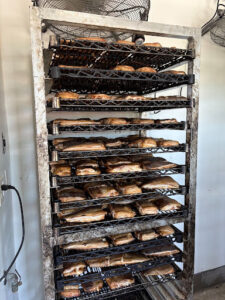 Starting bright and early, fish that’s been brined to be smoked gets loaded on racks and rolled into the smokehouse. The process takes around four to six hours for the fish to reach the ideal golden brown color. The day I was there, Emily noted that it only took about four hours, and I asked her why the time varied so greatly. To my surprise, weather is the main factor at play in impacting the smoking process. Wind and rain affect the circulation of smoke within the smoker, and it’s this circulation that affects how long it takes for the fish to turn golden. To be fully cooked through, the internal temperature of the fish needs to at least be at 145 degrees for half an hour. Once smoked, the fish needs to be cooled to 70 degrees within two hours, and below 41 degrees in another two hours. This is a process that’s managed by the health department, and is what prevents food borne illnesses or other pathogens. Along with the health department, they’re also managed by the DNR and department of agriculture, ensuring that the natural resource that’s being harvested is handled safely. The smoke house is constantly monitored for temperature, and something I thought was really interesting is that they use a specific wood for smoking. Since they first started smoking fish, Carlson’s has used sugar maple, and this is what gives their smoked fish a characteristic taste. There’s far more that goes into the smoking process than I imagined, so much so that it’s basically a science – one that the Carlson family has mastered and passes on generation to generation.
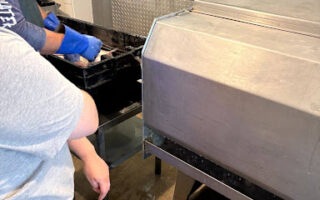
Reflecting back to when I was on the Joy with Joel, I remember seeing some of the fish that had gotten tangled in the nets, and how they would end up with a ring around their body. I wondered at the time if this would decrease their value, and as this experience has shown me, it does if they were to be sold fresh, but Carlson’s puts these fish to use in a different way. When the whitefish gets brought in from Joel, it’s first weighed and then sorted to be sold fresh or smoked. Due to these markings around some of them, those fish will get immediately sorted into the smoking pile since their aesthetic value is lower. Fish that go directly to the retail case are sent through a scaling machine that basically sucks the fish in from one end, and spits the freshly descaled fish out at the other side of the machine. The reason that smoked fish don’t get descaled is so that they don’t stick to the metal racks. Once sorted and prepped, the fish that is to be smoked gets put into a saltwater brine, and that’s where they will stay for at least 14 hours. Once the sorting and scaling process is finished, that’s when the fun really begins.
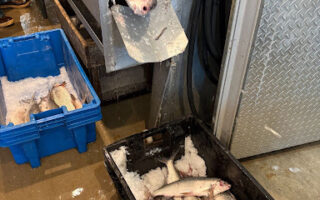
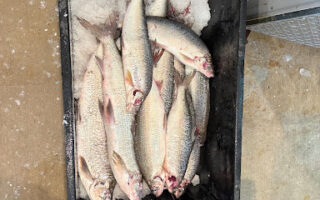
The back of the fishery clears out from the orderly chaos it once was, and transitions into an assembly line of fish fileting and bone removal. From my observations that day, four stations are formed alongside the table. The first group filets fish into two pieces and removes the head, the second group removes rib bones, the third group cuts out the pin bones, and the final group rinses and squeezes out any remaining blood. Mike Burda was stationed at the rib bone removal station, and with just one slice of the knife was able to cleanly cut them out. I’ve seen fishermen time and time again struggle with this step, so to say I was impressed would be putting it lightly. It felt like I was watching a master at work.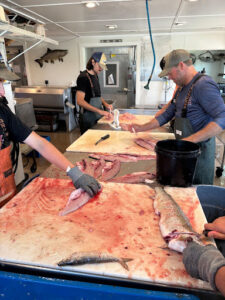
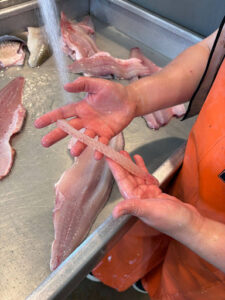 Something that Carlson’s has been doing that I find truly admirable is their mission to be zero food waste. This is a more recent initiative of theirs, and it means that 100% of the fish that gets brought in is used. Where the edible parts are sold like normal, they’ve gotten creative with the remains that one might expect to be thrown out. Guts and carcass remains of the body get saved and brought to Peshawbestown, and there it’s turned into fertilizer and compost. The pin bones get separated from this group, and this is where Carlson’s got really creative. These bones get ground up and put into their fish sausage, where they not only provide key nutrients such as calcium, phosphorus and collagen, but creates a delicious sausage from what I’ve heard. I love when businesses come up with innovative ways to use up their product because it shows their dedication to coming up with new things for people to try, and demonstrates their awareness for the waste that they produce. Creativity like this is what keeps customers coming back, and I think it’s a great way to promote sustainable practices, especially when considering how much waste is produced in the food industry. It’s uplifting to see people putting in the effort to lower the amount of waste that they create. Considering food waste is a major contributor to greenhouse gas emissions, this is a green flag to me that Carlson’s is conscious of their actions and actively working to improve the environmental footprint that they leave behind.
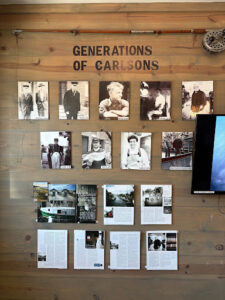 Moving towards the front of the shanty where the store is located is like stepping into an entirely different place. The front of Carlson’s is a quaint shop that has a comforting antique feel to it. Newspaper clippings and pictures from the past are pinned up, and it’s a funny feeling to know that while things may look different, some things haven’t changed. The smell remains the same, the heart of the product is the same, and the faces you see pinned up on the walls are the same faces who ran the business all those years ago. When a customer comes in to buy fish at Carlson’s, they’re greeted with a smile from behind the counter, rows and rows of delicious fishy products, and there’s a palpable feeling in the air of the hard work and dedication that’s been put in to ensuring that the family business is still running over a century later.
I thought Carlson’s was the end of the line for my journey with the whitefish, but as it turns out, there’s one more step I forgot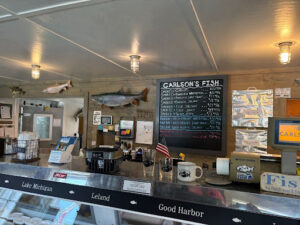 about. Carlson’s not only sells their products out of their storefront, but they also sell wholesale to many of the local restaurants in the area. I briefly experienced a “when worlds collide” moment where I was on my way out, and my boss was on his way in to put in an order of whitefish for the restaurant I serve at. It just so happens that the Leland Lodge is one of the customers that receives whitefish from Carlson’s. I guess this means that I truly get the whole experience, from pulling up the whitefish in a net, to processing them at Carlson’s, and finally getting to be the one to serve the fully prepped fish to a hungry guest at the Lodge. It doesn’t get more full circle than that. In a world where our food gets shipped in from all over the world, It’s refreshing to know that I was able to follow this iconic dish that defines Fishtown from start to finish, and I never even had to step foot outside of Leland.
The last blog drops next week, so get ready for the grand finale!
Emma
Check these other articles out!
- Carlson’s website
- Learn more about why Carlson’s zero food waste goal makes such a huge difference
- Why eating local is important
- A super cool organization that demonstrates the different purposes fish has
- Fish bones health benefits study
- Fishtown: The Book
- https://www.fishtownmi.org/shop/
- Available for purchase online, at the Fishtown Welcome Center, and the Leelanau Historical Society Museum
- Laurie Kay Sommers, Heritage Award Nomination for Carlson’s Fishery, revised 2013