
 This is the first summer of my life where I’ve been out on Lake Michigan this many times. Four trips in total so far, and while that might not be many for some, I take it as such a blessing. Lake Michigan is so deeply embedded in who I am, from summer days spent swimming and rock hunting, to nights on the shorelines enjoying a campfire or stargazing, I’ve never felt more connected to a place than I have with her. This summer I’ve loved getting to experience the lake from a different perspective, and getting to go out and experience her deeper waters has been such an incredible opportunity to fuel my academic interests as well as my own passions. Where I’ve come to appreciate the lake for more leisurely activities over the years, this summer has been a great first step into learning the history of the lake, and how others have made use of the waters.
As some of you may remember from last week, when I visited the Manitou Islands with Geoff Niessink, captain of the Manitou, we weren’t able to get the full experience of the Crib due to the weather that kept us from being able to get on to the lighthouse. Fishtown is a place that’s always overflowing with opportunities though, so I had a feeling I’d find a way to get back out. Where there’s a will, there’s always a way.
As luck would have it, a few days after my outing to the islands, the opportunity to actually go out and get an official tour of the Crib fell into my lap. My home base of work is at the Fishtown Preservation Society (FPS) office, which is located in the Leelanau Historical Museum. I happened to overhear one of the employees at the front desk mention that there was still space left on the upcoming Crib tour, and I jumped at the chance. This time, I’d be going out with a group, including one of the owners of the lighthouse, Dave McWilliam. Not only would I be able to get a detailed history of the lighthouse, but I’d also learn what the North Manitou Light Keepers (NMLK) have planned for its future use. NMLK is fully invested in this project, and serving as a 501(c)3 nonprofit organization, their work is purely for public interest, and to bring life back to a neglected part of Northern Michigan’s history.
Born and raised in Michigan, Dave has always loved spending his summers up north. Beyond Michigan, Dave works as a pilot for Delta Airlines, travelling across the world. What I find interesting is that of all the places on earth a pilot could travel to, he still chooses to come back to our little old town of Leland. Home is where the heart is, and for many who have experienced what Leelanau County has to offer, their hearts have settled here. It’s no wonder why so many return time and time again each summer.
Listening to Dave on the way out to the Crib, it was clear that the lighthouse has been a challenging project. From competing with others during the auction process, to clearing away the mess that the cormorants had made, and all the legal factors involved with getting the lighthouse in usable condition, this project required a group of people who were driven and confident enough to make their vision come to life. And that’s exactly what they’ve been doing since 2016. Together, a group of four families came together, the McWilliam family included, and have worked tirelessly since acquisition of the lighthouse to fundraise and restore it.
One of the most important things to understand about the functionality and purpose of the Crib, is its location in Lake Michigan. The Manitou Passage is a 16-mile wide channel that makes up the space between the Manitou Islands and the shoreline of Lake Michigan, and within this passage is a natural trench that cuts through a shallow sandbar region. This trench drops from the 20 ft depth of the sand bar, to around 140 ft. Why is this so important you may be wondering? As the saying goes, time is money, and this passage serves as a shortcut between Chicago and the Straits of Mackinac. By going directly between the islands and mainland rather than swerving around to the west side of the islands, it cuts each trip by about 70 miles, aka a LOT of time and fuel saved. Historically, it’s been very useful, but also very dangerous to freighters traveling on Lake Michigan.
Though its looks are deceiving with its striking blue water and calm appearance on a sunny day, this shortcut came at a price for many ships. Back in the days before GPS systems were developed, people had to rely on radio systems, and landmarks on shore to guide which direction they traveled in, and the Manitou Passage is a very difficult path to navigate. Anyone who needed to go between Chicago and the Mackinac Straits (freighters, sailors, schooners, etc.) needed to follow the mile wide trench, and if they were to drift off course, they’d hit the sandbar and become beached. This narrow trench is how the Manitou Passage gained a reputation as a graveyard of ships. Leading up to 1905 a few hundred ships in total were sunk, and it became clear that something needed to be done. While the need for a lighthouse was understood by 1905, Dave described that back then if the government didn’t have the funds for a project, they wouldn’t be allowed to start building. Instead, they parked a manned lightship (basically a floating lighthouse) at the spot where the Crib was to be located at the edge of the sandbar. Construction for the Crib lighthouse didn’t begin until 1933, and finished in 1935.
 Today, many know the Crib as a landmark in the northern waters of Lake Michigan, but back in 1935 it was a critical tool for ships to use as they navigated through the passage. This was a time when light saving crews and others who looked after the lighthouse took residence in shifts of three weeks on, and one week off the lighthouse. Though the crews left the crib in 1980, I learned recently that the Crib is still a fully functioning lighthouse that acts as a navigational tool. Every lighthouse has its own individual flashing pattern that allows captains and ships to identify lighthouses from afar, and the Crib’s particular light pattern is a red beacon that flashes every 15 seconds. This light atop the 63 ft tall lighthouse is visible for 14 miles before it eventually falls out of sight below the horizon line. This is not due to distance, but rather the natural curvature of the Earth. Contrary to what I thought about brightness being the limiting factor of how far away you can see a lighthouse from, its visibility is also tied to the actual height of the lighthouse.
For anyone else as unfamiliar with the Crib as I was, while I’ve been calling it the Crib this entire time, the OFFICIAL name is actually the North Manitou Shoal Light Station. A bit of a mouthful, so no wonder it got a nickname, but how did we start calling it the Crib? If we circle back to the actual construction process of the Crib, the base was made on land with timbers, then floated out, filled with rocks and sunk to the bottom, where it provided a foundation to drive metal sheet piles down to then fill with concrete. This timber frame was shaped like a “crib,” and is where the nickname of the lighthouse originates from. The nickname was used early on after the Crib was built, and has stuck ever since.
 The North Manitou Shoal Light Station was originally built and owned by the U.S. Lighthouse Service, with ownership transferred to the U.S. Coast Guard in 1939. In 1980 it was mothballed and became automated, and remained unmanned (except for occasional maintenance) until 2016 when the NMLK took ownership after the lighthouse was put up as capital surplus. Dave and his partners bought it through an auction, which at the time of its sale sounded like far more work than it was worth to restore. But where many saw a hopeless wreck, NMLK saw a diamond in the rough. If you look up pictures of it today compared to what it looked like before the repainting and cleaning, it was absolutely covered in cormorant guano, some areas being four inches thick. That’s a lot of bird poo if you ask me.
Cormorants were once endangered, and are now a protected species, making them a very difficult pest to manage. They like to perch wherever they can, and due to their fish-heavy diet, the guano that they produce has an especially rotten smell to it. All my life, I’ve had this irrational fear of getting pooped on by a bird, and having to face the public humiliation that comes as a result. Turns out, it’s definitely not an irrational fear because as luck would have it, within the first 15 minutes of stepping foot on the lighthouse I got SHAT on by the only cormorant on the entire Crib. If there’s anything you take away from my blogs let it be this. If there’s a bird around, you’re never safe from becoming its next target. If you find yourself parked anywhere below or downwind of a bird, I’d suggest moving before it’s too late, because some of us have to learn our lesson the hard way.
Once the lighthouse was cleaned up, tours were able to run more regularly. Most of 2017 was spent cleaning up the guano, and the repainting lasted 2017-2018. After interior restoration is complete, the hope is to offer regular tours and overnight stays. As it turns out, this is a very slow process due to the number of permits that are needed to allow people to stay the night. The actual logistics involved with transportation to and from the island, as well as managing the sewage that will need to be transported to the mainland to be disposed of are also hurdles. A hefty project, but I think there’s no better group to be in charge of bringing the vision to life than the NMLK. As you approach the lighthouse today by boat, it’s no question as to why it’s such a stunning landmark. Even with the wear and tear within the lighthouse, the dominating presence it has on the water combined with the fresh coat of paint the NMLK gave it allows people to see the beauty it had back when it was first built, and the potential for its future guests.
Upon first entering the Crib from the sea door, my first thought was that it had a very familiar smell to it. Sort of damp, mildewy, dusty, and maybe a hint of gasoline or paint mixed in. It had the same smell of a pole barn or garage, and makes me wonder what it is that gives these places the same distinct scent. The basement area was unfinished, and mostly consisted of random tools and supplies that were strewn about. Water droplets clung to the walls and ceiling giving the space a damp and cool temperature that I’m sure used to come as a relief on hotter days. When we first walked in, my friend turned to me and  said that it felt haunted. I couldn’t agree more. I don’t know how much I believe in those sorts of things, but I couldn’t deny the eeriness of the space. We were assured that no one had ever died at the lighthouse (at least according to records…) and that chances of there being ghosts were minimal. That being said, it still begs the question of where the lost souls go that went down with the ships before the Crib was built. Perhaps some may have found the Crib to be a good place to spend their afterlife.
Up until now, I’d wondered why anyone would’ve wanted to be isolated at the lighthouse for three week periods. Not only did it sound boring, but also a bit lonely, but moving up onto the main deck of the cement base, we found ourselves outside and the view was nothing less than stunning. The sun was hitting the water so that it looked like a bedazzled sea of sparkles spanning out in front of us. The sky was clear and blue, and a cool breeze kept me from getting too warm under the sunny rays beating down on us. In another life, I could imagine myself as a lightkeeper. Maybe in the 1960s or 1970s, waking with the sun, prepping a nice strong cup of coffee, and sitting outside for the first 30 minutes of dawn. Maybe with a book too. Or whatever it is that lightkeepers used to do in the morning. I know in the true position of a lightkeeper there’s a never ending list of responsibilities to tend to in the early hours of waking, but let’s just say in my imaginary world where I was a lightkeeper, I would’ve been reading and sipping my coffee, living the coastal life I was born to live. Dreams aside, the view really was spectacular, and I see a bright future ahead for the lucky visitors that get to come out and experience a morning on the Crib once its restoration is complete.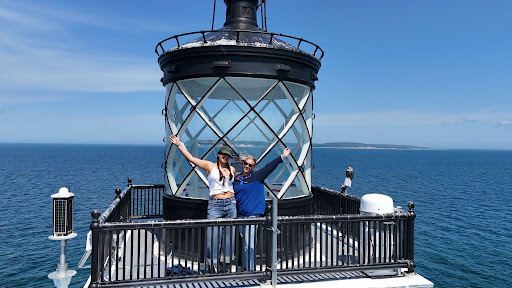
Once our group made it all the way up to the top of the lighthouse, we emerged in the room that held the light, and connecting to it was the door that led to the outside area with a railing and overlook. It was so beautiful that my friend and I couldn’t help ourselves from taking pictures, pretending as though we were on vacation. In reality we were 30 minutes from home, atop a lighthouse overlooking a lake that could’ve been mistaken for the Caribbean. Lets just say an experience was definitely had.
In just two short trips out to the Manitou Islands and Crib, I feel like my brain has been flooded with fun facts and stories. For so many years, I’ve heard of the Crib through conversations with friends, and all I ever knew it as, was “just some  lighthouse.” No one seemed to know much more beyond that, so I never really cared to explore what it was, or thought to actually go out and see it. I have a newfound understanding of the Manitou Passage, and how the dangers that ships faced in the past were what led to the construction of the Crib. Not just a beacon of light in the distance, but a life saving station that stands guard over the graveyard below and prevents others from succumbing to the same fate. Having now been to both islands and the Crib, my curiosity has been amplified and I can’t wait to read more about these places and go back and visit in the future. I think offering tours and overnight stays at the lighthouse is a great opportunity for people in the future, because the story deserves much more attention than it’s gotten. More visitors is exactly what this lighthouse needs for exposure, because it’s the story that gives it not just purpose, but also life.
See you all next week,
Emma
More Sources!
- Info about the lighthouse: https://www.history.uscg.mil/Browse-by-Topic/Assets/Land/All/Article/1969046/north-manitou-shoal-light/
- North Manitou Light Keepers website: https://northmanitoulightkeepers.org/
- NPS article about the Manitou Passage: https://www.nps.gov/articles/000/booms-and-busts-of-the-great-lakes-and-manitou-passage.htm