
 If I’ve learned anything in the last month, it’s that there’re people in Fishtown who love the sport of fishing, those who find it boring and can’t get far enough away from the smell that comes with it, and then there’s Joel. Joel Petersen, Captain of the trap netter Joy, eats, sleeps, and breathes fishing, and that might have something to do with the fact that it runs in his blood – four generations of it to be exact. He first learned to fish in Muskegon where his family’s commercial fishing business is located, and came upon the opportunity to captain the Joy when he was up north visiting the area.
It was fall 2007, and just months since the Fishtown Preservation Society (FPS) had purchased the Fishtown shanties and the commercial fishing vessels Joy and Janice Sue. Joel and his cousin had heard that FPS also acquired the fishing licenses, and they made the 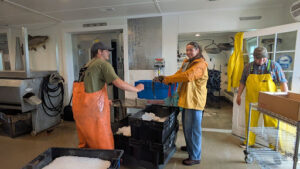 journey up north to advocate that FPS start using the fishing licenses as soon as possible, otherwise the DNR would take them away. This was the push that Amanda Holmes, executive director of FPS, needed to make the decision to prioritize the restoration of the vessels at the same time as the shanties. To keep the historical integrity of Fishtown alive, meant that the vessels needed to remain in operation and be able to continue fishing on Lake Michigan just as they did in the past. Joel and Geoff Niessink, both skilled welders and experts in caring for Great Lakes steel vessels, did the restoration work, and in 2009 the boats were ready to be back in action.
The fun thing about this summer is that I get the freedom to experience different activities revolving around Lake Michigan each week. I’m almost positive that when I go back to school this fall I’ll be the only one out of my friend group that can say they experienced a day in the life as a Great Lakes commercial fisherman. I’ve spent my whole life wandering the docks of Fishtown, admiring the shanties and boats lining the river and the thought that I could do more than just look never crossed my mind. It’s one thing to stroll through the weathered shanties, but it’s another to hop onto the Joy and be transported back in time, experiencing the same conditions of catching whitefish today as it did in the past.
I won’t lie, I was a bit nervous when I first agreed to join Joel for the morning. I have a history of getting TERRIBLY motion sick, and oftentimes when I’m on the water this results in seasickness. In fact, I was even more afraid of getting sick and embarrassing myself than I was of falling over the edge (don’t worry, no one’s actually gone overboard on Joel’s watch), but thank goodness neither were the case and I was able to hold myself together throughout the morning.
Commercial fishing on the Great Lakes is a struggling industry in Michigan. From invasive species impacting whitefish populations, changing climate, and the increasingly strict regulations behind the licenses and permits, these days it seems like there are more things working against the commercial fishing industry than there are supporting it. Only some of the most resilient businesses can stay afloat, and Fishtown has survived because of the preservation society’s tireless efforts and people like Joel.
For those who may be unaware, the Joy and Janice Sue in the Leland River are more than just a symbol for Fishtown and Leland. They are active commercial fishing boats that are owned by FPS, and are typically active between April-September. During the fishing season the Joy goes out once a week to check the trap nets that are set out for whitefish, and though the license owned by FPS allows for up to ten nets to be out at one time, there are only five that are out currently. The Janice Sue is licensed to catch chub, but for this season she is undergoing maintenance. 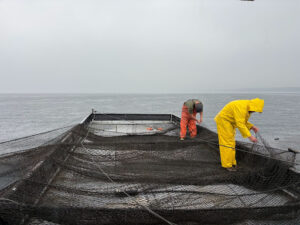
In order for these boats to remain active, there is a vast amount of work that needs to be done to maintain the vessels and fishing equipment. Nets need to be repaired frequently, as any tears can allow for caught fish to escape, and while some repairs can happen on the Joy when the nets are being lifted, things like latex coatings and other care require an immense amount of space onshore. These nets are larger than most can imagine, and range between 250-300 ft in length (roughly the size of a football field), which makes for tricky handling. Folding the nets in a certain way helps for end of season storage and tangle prevention, and the latex coatings that are applied every five to six years protects the ropes from deterioration. These processes require time and patience, and are only a few pieces of the elaborate puzzle of skills that a commercial fisherman must possess.
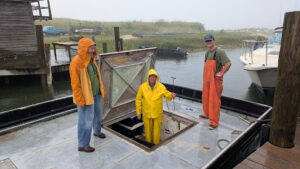
Spending a day on the Joy means to start before sunrise. When was the last time I was up that early? I couldn’t tell you. I was up at 5:00 am, on the Fishtown docks by 6:00, and on the water by 6:30. Joel, his nephew Sean, and myself made up the crew that day, and it was heartwarming to see the family knowledge of fishing being passed onto another generation. The rhythmic rocking of the boat and the humming of the motor creates the perfect conditions to fall asleep, and that’s exactly what happened to me. The nap was brief between pulling nets, and it was an unspoken acknowledgment between Joel and me that this was an 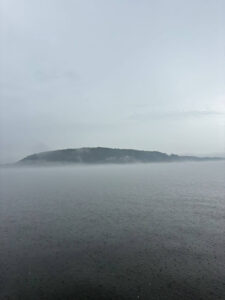 exclusive occasion where I could get away with falling asleep on the clock.
Conditions were calm making for a smooth early part of the trip, but an ominous fog that hung overhead indicated otherwise. Soon enough the rain started, but it takes more than rainfall to disrupt the day of a fisherman. The peace of being the only ones on the lake in those early hours, and feeling the cool mist on my face is something that I’ll never forget.
I’ve heard of how tough the fishing industry is during my time here at FPS, and with all the factors at play outside of a fisherman’s control it can be difficult to see the appeal of this profession. It took only a few minutes on the boat, however, to understand why there are still people dedicated to keeping commercial fishing alive. Being a commercial fisherman, especially in historic Fishtown, is about keeping traditional practices alive and dusting away the cobwebs that can obscure what commercial fishing means for Leland. Bringing people together through food, education, and history are some of the fundamental aspects that allow Fishtown to thrive as it does today. Engaging visitors and showing them the depth and richness of Fishtown’s story is what keeps people coming back. The shanties aren’t just for vintage appeal, and the tug boats aren’t just eye candy floating on the river. They’re pieces from our past that work together to keep the memories alive of the families that were here in Fishtown’s early years, and are active components right in front of us that demonstrate what it takes to keep commercial fishing and other local businesses running smoothly.
One of the things that I’ve learned from Joel is the harsh reality commercial fishermen face when it comes to catch allowances and who gets to catch what. Some of the most popular fish people love to eat – trout, salmon, walleye – are all illegal for commercial fishermen to keep if they’re pulled up in the nets. While this is a highly debated and scrutinized topic in the broader fishing community, it boils down to the opinion that these rules should be in place to protect fish stocks for recreational fishermen. Recreational fishermen claim that the reach of their industry generates more revenue for the State of Michigan compared to the commercial fishing industry. The argument here is that sports fishermen bring in large numbers of tourists and serve as a main attraction, but many of those tourists are coming to lakeshore towns, like Fishtown, seeking locally caught fish in restaurants to have for dinner. Commercial fishermen are dedicated to putting food on people’s plates that is not only fresh and healthy, but also caught locally. Most people can’t and don’t want to catch their own fish, which makes this a product in high demand. Without commercial fishermen, restaurants would not be able to offer the beloved whitefish dinners, and tourism would suffer as a result. Michigan Sea Grant reports that
  90% of the seafood we consume is sourced out of the country, and commercial fishermen are helping to increase our food security by providing locally caught fish.
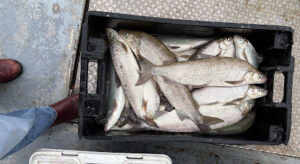
Throughout my morning on the Joy, I could feel the disappointment as each net was brought up, only to be filled with trout. Whitefish and trout often swim by each other and the benefit of the trap nets is that they allow for live catch, meaning the fish that are thrown back can survive. One thing that many people are not aware of is that trout are part of a stocking program in the lake, whereas whitefish are not. The unfortunate part of fishing is that when the nets get pulled up and a majority of the catch is not whitefish, the trips out can become a waste of time, energy, and fuel. Luckily of the five nets we pulled, most had some whitefish and we ended up with a decent catch to bring into Carlson’s Fishery at the end of the day. After six hours of hauling nets in and out of the water, seeing the harbor and docks was like seeing an open embrace, welcoming our crew back to shore. As much as I enjoyed being out on the water and getting the chance to further develop my sea legs, I was relieved to see land and even MORE relieved to discover that I had outgrown getting seasick.
The perception that commercial fishermen are the cause for declining fish populations is outdated and incorrect. The real cause for fluctuations in fish populations is due to invasives and shifting climate. The first major problem was the sea lamprey that took over the Great Lakes by the 1940s, and then the zebra mussels in the late 1990s. These species wrought havoc on the fish populations during their peaks, but in the case of the zebra mussels, they were more suited for shallow and warmer water and Lake Michigan didn’t meet these criteria. This was not the case for the sea lamprey, and they needed more of a hands-on intervention program. The U.S. and Canadian governments worked together to come up with a strategy targeting sea lamprey in their spawning and larval stages. Methods implemented were lampricides, physical
 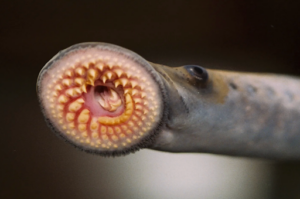 barriers to block access to spawning grounds, and traps. The results of this were very effective and reduced the population by 90%.
As encouraging as these stories are, as soon as one issue is resolved, another is quick to take its place. The next invasive struggle was the quagga mussels, and they are still an issue to this day. Appearing around the time when the zebra mussels did in the 90s, quaggas prefer deeper and colder environments, and where Lake Michigan missed the mark for zebra mussels, it’s the perfect habitat for quagga mussels. As filter feeders, mussels filter phytoplankton out of surrounding waters. This gives Lake Michigan its clear and picturesque appearance that people know and love, but is harmful to whitefish and other fish populations. Baby whitefish rely on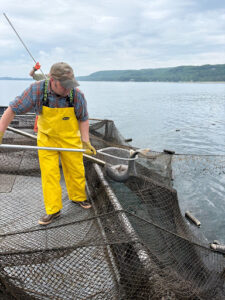 phytoplankton, and the quagga mussels make it so that certain areas are nearly devoid of phytoplankton. Not only is this a food scarcity issue for young whitefish, but with the clearer waters the sun filtering through can be so bright that it burns and ultimately kills these juvenile fish as well as the spawn. This issue is part of why commercial fishermen have been seeing less whitefish, and advocate for allowances of other fish species in order to continue putting food on people’s plates.
When asked what he’d be doing if he weren’t fishing, without missing a beat Joel’s response was that he’d be working on freighters. Some people are meant to be on the water, and it’s interesting to see how everyone is tied to Lake Michigan in different ways, especially in a small community like Fishtown and Leland. It’s apparent to me that Joel is right where he wants to be – in a place that he loves, doing what he loves. I’ve always heard the saying that if you find a job that you truly enjoy, you’ll never have to work a day in your life. These days the job market feels so daunting, especially as someone who will be graduating from school in the next couple of years. I find myself chasing that same feeling of fulfillment that matches Joel’s drive for fishing. The people that are able to stay and make their livelihoods here give depth and character to our town, and I find that their passion for what they do is clearer than Lake Michigan’s waters.
Stay tuned till next week 🙂
Emma
More source to check out
- https://www.michiganseagrant.org/michigan-fresh-fish/
- https://www.glfc.org/control.php
- https://www.michiganseagrant.org/topics/fisheries-and-aquaculture/commercial-fishing/
- https://www.michigan.gov/dnr/managing-resources/fisheries/business/commercial
- https://www.glfc.org/sea-lamprey.php
- https://www.adkwatershed.org/zebra-and-quagga-mussels