
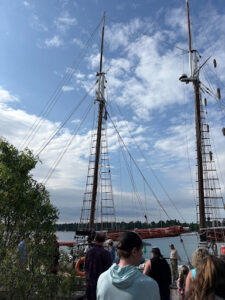
 If you drive 15 minutes east of Leland on M-204, you’ll find yourself in another charming little village. Sitting along West Grand Traverse Bay, Suttons Bay is a water focused town, much like Leland. Last week I took a break from my routine of exploring out of Fishtown and paid a visit to Suttons Bay for a special opportunity that was, you guessed it – out on the water.
For those who may be unfamiliar with it, the Inland Seas Education Association (ISEA) is a nonprofit organization that operates out of Suttons Bay. Founded in 1989, the organization’s mission is to not only spark curiosity for the Great Lakes, but to also educate and inspire stewardship for people of all ages. The first time I heard about ISEA, I was a 6th grader on a class field trip with their schoolship program. I remember feeling like a little scientist that day, testing water quality and building an 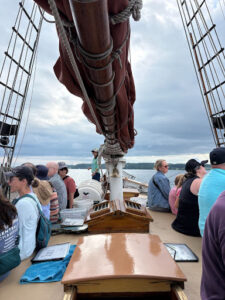 aquatic ROV. I hadn’t thought about it before, but there’s a good chance their program is part of what led me to the environmental field. Living proof that their efforts worked on at least one child that day! I remember back then just how large the boat felt, and when I stepped back onto the Inland Seas this past week it felt like I was 11 again, as awestruck by the magnificent ship as I was all those years ago.
The Inland Seas schooner is one of two that ISEA now owns, and the second one is the Alliance. These schooners travel all around the Great Lakes to various ports where they host hands-on educational programs on board the vessels. What makes a schooner different from other vessels, is what’s going on above the waterline. Schooners require at least two masts, where the first mast is always known as the foremast, and the second mast must always be the main mast as it carries the most amount of sail. The educators on board with us described the schooner as a fore and aft rig, which basically means highly maneuverable. With the sails being set up lengthwise along the center of each ship rather than horizontally across, it allows for schooners to sail closer to the wind. With ease of movement on the water, it means that less people are required to operate it, so a schooner of the size that we were on (77’ long, 66’ high) can be managed by as few as three people.
Back in the 1840s and 1850s, there were around 1000 schooners in operation on the Great Lakes. In those days, they were utilized as efficiently as possible. Passengers would be brought to the docks, and once they were dropped off the ships would be loaded with commodities such as lumber, iron ore, and fish. The Great Lakes were the original passageway of the Midwest. Before highways and even railroads, the water was the quickest way to transport goods from one coastline to the other. It’s wonderful how ISEA has preserved this part of history by continuing to use schooners as a modern day classroom for learning, and embedding the history of the schooners in their programs. Like a lens into the past, the Inland Seas is constructed the same as traditional schooners were back in the 1700s and 1800s. One of the educators pointed out that if you were to bring a crew member from the past onto the boat today, they would be able to name every rope, every beam, really any part of the ship besides the motor, radio, or GPS (modern day technologies). It was pretty cool to experience one of the many programs ISEA offers, and it was a great way to compare my past expeditions out of Fishtown. Having the chance to interact with so many nonprofit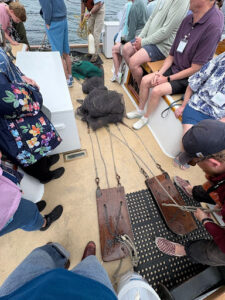 organizations this summer, it’s been eye-opening to see each niche that they’ve focused on within the county, and I’ve seen how each of their missions align to compliment each other unknowingly. ISEA focuses on Great Lakes education, North Manitou Light Keepers focuses on restoration of the Crib lighthouse, and Fishtown Preservation Society focuses on supporting historic Fishtown including the commercial fishing that takes place there. Each directs efforts towards integral parts of Leelanau County, and through this promotes cultural and environmental literacy within the region.
Once aboard the ship, we set sail and dropped the otter trawl within the first five minutes, trawling along the bottom of the lake. Since the program first launched in 1989, ISEA has made sure to trawl for ten minutes, and ten minutes only. This is because when you’re collecting data, you want it to be data that’s consistent. To have consistency, you need a constant variable, and in this case, time is that variable. It just goes to show that even during these fun, seemingly simple activities thrown into the experience, what the crew is doing is strategic and important to science and research on the Great Lakes. What’s shaped as a fun and brief experience for us still contributes to a greater purpose.
When deciding which program to sign up for, Fishes of Lake Michigan caught my attention immediately. I was curious to learn 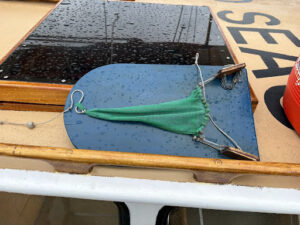 more about the different species that live in the lake, and was excited for the hands-on approach that the program offered. We started out trawling to look for forage fish to examine, and these are the fish that act as food for larger species. Many of them typically measure around < four inches, which was very different from the last fishing experience I had on the Joy where we pulled preset nets in Lake Michigan in search of whitefish (a larger species). Later during the ISEA trip, we got to take a closer look at some of the fish we caught, and we were able to identify what they were based on head, tail, and dorsal fin shape, as well as how many spikes they had growing along their back. Some of the fish were so tiny, it was difficult to see the spikes. I was almost worried the fish would get squashed while holding them and trying to pinpoint the number of spines, but we managed to examine them without causing any damage to their delicate bodies.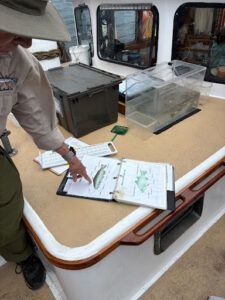
As luck would have it, most of my adventures this summer have gotten me on or near the water. However, it seems that wherever I’ve gone this summer the rain finds a way to follow. While out on the lake, we experienced a period where we were just PELTED with rain, and the wind picked up to the point where the schooner was heeling (tipping) so far over that the edge of the deck was nearly touching the water. Many of the children on board did NOT enjoy this, as I imagine this likely felt like a near death experience in their eyes. Personally, I had a great time, and enjoyed the rush of adrenaline that I got from the experience. I was less concerned than the kids were, but that’s because I’d spoken to the captain earlier in the day and asked if the schooner had ever tipped over, and I was reassured that it was mechanically impossible. Not only would the leaded weights readjust the boat to prevent it from tipping over, but once the sails dip past a certain degree, the wind will stop catching and the vessel will straighten itself up again. Luckily I had that reassurance in the back of my mind, otherwise I would’ve been a tad more concerned about the situation.
My favorite part of this day was #1, the near capsize, but also #2, that one of the fish we caught was a goby, which I photographed to prove that it’s as cute as I said it was in my last blog. I finally know what it is that makes me like them so much (even though I know it makes no sense to care for an invasive this much). Someone compared them to looking like frogs, and I think that must be it. Something about how their eyes sit on the top 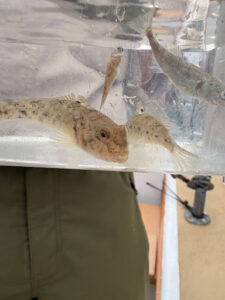 of their head make them look so dinky, I just love that about them. This is where I have to come in and remind myself that for as adorable as they are, at the end of the day it’s not a good thing that we’re seeing them so often in Lake Michigan. As an invasive species, their ever growing population is exactly the reason they’re an issue, especially since they’re such troublesome competition for our native species. Gobies aside, I love that I was able to see some other smaller Lake Michigan fish up close, and the hands-on experience that ISEA provided was exactly what I was hoping for. I applaud them for putting together a program that was as enjoyable for adults as it was for the children, it seems like a difficult thing to do.
I think something I was most surprised about, was that a lot of the information the educators shared I was already aware of. This isn’t to say that the information they talked about was repetitive. Even as an environmental major, had I gone on the ISEA trip earlier in the summer I think I would’ve been much more surprised by what I was hearing. Much of what I heard in discussion were things that I’ve learned in an intensive way over the past two months. Where I took my time, experiencing different places and talking to new people to gather the knowledge I had, the ISEA program gave an overview of many of those topics within a two hour crash course, which just goes to show the well rounded program they’ve created over the years. This was the first time all summer where I realized just how much I’d learned over the summer, and at the end of the day I think that’s one of the biggest things people can hope to take away from an internship or job.
Midway through our trip, we were told that we would pause for two minutes of silence because it’s one of the best ways to truly experience being out on the water. As animals, we use our senses to observe the world around us. Taking those two minutes of silence allowed us to focus on what we were hearing, what we were seeing, and what we were smelling. This is probably what I’ll remember most when I look back on that trip years from now. Hearing the gentle sloshing of water 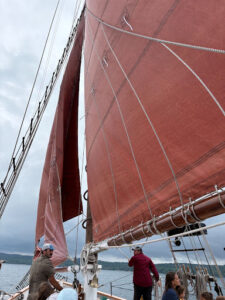 hit the hull, the tightening of ropes from the wind pushing at the sails, for a minute it was like I was in the middle of a Hollywood scene on the Black Pearl from the Pirates of the Caribbean movie. The importance of slowing down never ceases to amaze me, because it’s so hard to do in the time that we live in. With screens always in front of our faces, videos broken down into clips lasting a matter of seconds to keep up with our shortening attention spans, it’s too easy to forget that we can stop and simply enjoy our surroundings for what they are.
This trip was a great way to make a connection between everything that I’ve been learning up until now, and it was wonderful to have a water-based experience from another town in the county. The Inland Seas Education Association provides not only a great learning experience for all ages, but also allows guests to embark on a vessel that’s a critical piece of Michigan’s maritime history. The magnificent schooners that the ISEA use as a platform for teaching science are also important to sharing the rich history of the Great Lakes, and keep that part of maritime history alive. Each and every crew member was eager to be on board that day, and their excitement was contagious. The joy they have for their work added to the whole experience, and I cannot recommend ISEA’s sailing excursions enough because even if it rains you’re bound to have a good time.
July may be winding down, but the blogs are still coming! I’ll see you all next week in the latest fishy edition.
Emma
Check these out!
- Book your own Inland Seas outing here: https://fareharbor.com/schoolship/items/calendar/2026/07/
- Inland Seas main webpage: