
I feel like there’s been a lot of weird weather this week, but I’ve enjoyed the haziness that’s been hanging over Leland recently. It gives Fishtown this mysterious allure and I’m really into it. I’m lucky that I’ve lived here for long enough that I’ve seen Fishtown on countless sunny days. It’s times when the fog and rain give Fishtown a different look that I find this place even more beautiful.
If you’ve followed along with my last couple of blogs, I’ve made my love for Lake Michigan apparent. I had the chance to speak with someone last week who shares the same passion to protect the lake, and who understands the importance of this water source. Dr. Julie Peller is a water chemist who teaches at Valparaiso University in Indiana. Living near the southern tip of Lake Michigan, she’s always appreciated the beauty and splendor of the lake, but her interests go beyond the lake’s aesthetic value. Her interests in water quality stem from a background in organic and environmental chemistry, and more than 12 years ago she began focusing on the impact of plastic pollutants in water when the term “microplastic” began appearing more frequently in the academic and public settings. Her curiosity led her to ask what is actually in Lake Michigan’s waters (pictured here are microplastics from NOAA).
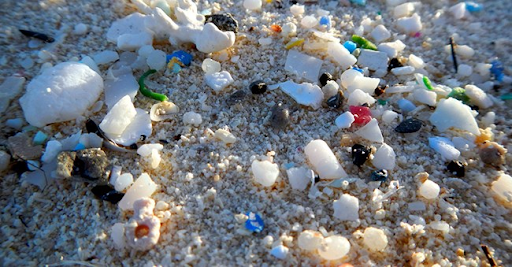 Since then, Dr. Peller’s work has bounced between fieldwork and lab analysis, where she investigated microplastics in local tributaries. She’s been working to determine the best ways to remove and keep these particles out of our water, and her research has shown that this is a very difficult goal to achieve due to their microscopic size. One of her latest projects is removing microplastics from the shorelines of Marquette Park in Indiana, with the hopes of restoring the ecosystem that has been polluted. Some collected pieces are analyzed with IR spectroscopy in her lab, which identifies plastic type and oxidization.
I went into this conversation with a baseline understanding of what microplastics are and what they do, but they were just that. Baseline. This was a wonderful chance to talk to someone who is an expert in their field, and gave depth to my understanding on these topics that I’ve covered in lectures and class readings. I find her story of turning an interest into a career inspiring. It’s easy to talk about something you’re interested in, but it takes someone truly dedicated to take action and influence change.
There’s a lot of media attention around plastics in the oceans, and I’m sure many of us are familiar with the “Save the Ocean” campaigns. Many people forget that Lake Michigan, even with what appears to be her clear waters, is not exempt from plastic contamination. Sure, there aren’t large islands of trash floating on the surface like there are in the oceans, but there is still micro and nanoplastic contamination coming from all over the place, and these plastics are forever pollutants.
Dr. Peller describes that the plastics we use in everyday life are what get broken down into smaller pieces. Synthetic products from clothes, to packaging, detergents and more, are all sources for where microplastics come from, and goes to show how these contaminants have infiltrated nearly everything we use. Even when water goes through treatment plants, up to 10% of microplastics will still be present. Once they’re in our water system, they’re essentially impossible to fully remove.
By definition, microplastics are particles ≤5 mm, and nanoplastics are particles ≤1 μm. To give you a clearer picture of what that means, microplastics range in size from the eraser at the end of a pencil, all the way to the size of a bacterium. Nanoplastics, on the other hand, can be 100 times thinner than a strand of hair. This rings an alarm bell for me because these plastics are small enough that they’re making their way into ecosystems and into the bodies of animals, fish, and people. Issues that impact Lake Michigan’s ecology puts an emphasis on the need for public awareness. The less plastic we consume in our region, the less risk there will be for the fish, ultimately maintaining the livelihood of places like Fishtown.
On the surface, our region appears well cared for, but just because we don’t see a lot of litter doesn’t mean that microplastics aren’t leaching into Lake Michigan. The tourism that supports Northern Michigan (Leland included) attracts people from across the world who then crowd into scattered towns along the shoreline of Lake Michigan. This creates a concentration of plastic products – especially single use items like travel toiletries, water bottles, grocery bags, children’s toys, and food packaging. As a reminder, plastic products on their own do not make up the entire issue of microplastic contamination. It’s the combination of plastic presence and daily activity/usage by people that causes the gradual breakdown of these products. The resulting outcome is a release of tiny plastic fragments that wash into local tributaries and eventually make their way into the lake.
 To help understand and deal with this issue, in 2021 Dr. Peller founded the Plastic Reduction Alliance (PRA) and currently sits as its executive director. Officially established as a nonprofit in 2025, the PRA is an advocate for cleaner communities, watersheds, and advocating for the elimination of unnecessary single-use plastics. I’m not advocating for the banning of all plastic, because I fully understand that there is a time and place for the use of plastics. There are, though, a lot of things that we can do to change our consumption habits and lessen demand. People, including myself, love convenience. If something seems inconvenient in our lives we are less likely to make a specific change. If we’re able to normalize carrying a reusable water bottle, why can’t we normalize carrying around reusable cutlery? Reusable straws? Reusable bags? These are little things we can implement into our lives that aren’t costly, require minimal effort, and at the bare minimum make you feel good about yourself when you’re able to turn down a plastic bag at the grocery store.
Single-use plastics are only as widespread as they are today because of how cheap they have become. Plastic bags, film wraps, , straws, packaging, the list goes on. Why are they so inexpensive? Because they’re subsidized, making them the cheapest material for manufacturers to use. This is how single-use plastics have grown to be such a large part of our lives, and will continue to be if we don’t do something about them now. To some, legislation on single-use plastics may sound extreme, but doesn’t every major change have to start somewhere? Take seatbelts for instance. Once opposed due to the “thrown clear” myth, where it was a common misconception that being thrown from a car was safer than becoming trapped within, today we know that this idea was wrong and seatbelts have been proven to save lives. There will always be people who disapprove, especially when the change is new. Dr. Peller says that the best way to combat plastic waste is at the legislative level. This would be legislation to reduce the manufacture of these plastics, as well as to hold producers responsible for what they put into the environment, and I agree with her.
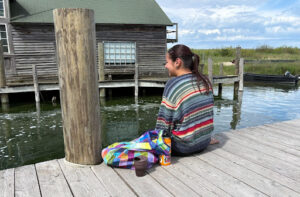 I’m writing this blog to learn and to share my experiences on a variety of these topics. A world where we limit our use of single-use plastics is achievable. I know this because I was fortunate enough to study abroad in Copenhagen this past semester, and if you know anyone who’s gone abroad for a period of time, it’s a stereotype that they looooove to talk about it. Not to be cliche but I’m no exception. It was a surprise to me on my first trip to the grocery store that no one relies on plastic bags in Denmark, or in much of Europe for that matter. If you need one, you have to pay for it because of the taxes that are now put on plastic bags, so everyone carries around their own reusable bags. While it was inconvenient and annoying at first, it took me only about a week to adapt to this habit and it gave me a GREAT excuse to get some fun reusable bags of my own. I had some Danish roommates, and they told me that as good as the Danes are today about using their own bags, it was not an easy switch. Not many liked it at first, but they grew to accept the change as time went on, and eventually it became a way of life. I found the Danes to be progressive and dedicated to sustainability, and while you can’t really compare Denmark and the US on the same scale due to the sheer size difference (land and population) there’re still parts we can learn from.
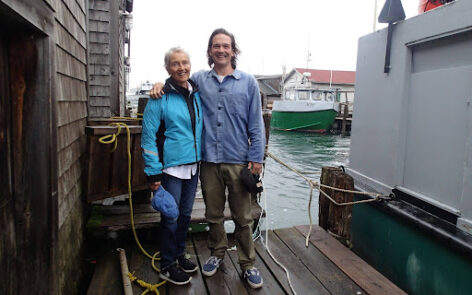
Pictured above Ann Stack with her son on the Morris Shanty docks. Ann’s family goes back to the early 1900s in Leland. Daughter of Adalia Morris, her family has played a significant role in keeping commercial fishing alive in Leland.
Locally, I want to highlight something to look forward to that the Fishtown Preservation Society is planning to have installed by next summer. Thanks to the generosity of Ann Stack, a long time Leland summer resident, FPS is installing a refillable water bottle station in Fishtown so visitors will be able to refill their bottles. Baby steps like these are ways that an organization can encourage the public in a sustainable direction, and provide water for those who bring their own bottles. This doesn’t mean you need to target every single area of your life. It’s often more effective to choose one thing to direct your efforts towards and stay consistent with rather than try to do everything all at once and not be able to fully commit. For now, I’m focusing my energy on adjusting one habit at a time, until it becomes easier. Once something becomes instinctual, then I know it’s time to move onto another goal. Now that I’ve developed the habit of shopping with reusable bags and carrying a refillable water bottle, my next goal is to keep a reusable straw on me (coffee shops are my weakness). You may not realize it, but there are businesses in this region that also encourage sustainability through their products. If I’ve influenced anyone to get a reusable bag of their own, Wild Lettie in Fishtown and Suttons Bay has some reaaaally cute bags made of recycled products. I’d definitely recommend taking a peek and buying smart, buying sustainable, and buying local.
See you guys next Tuesday,
Emma